



The seller makes the goods available at its own door under EXW, and the buyer takes on almost everything from that point on, including export clearance. FCA keeps the seller on the hook one step longer: the seller must clear the goods for export and hand them to the buyer’s nominated carrier before responsibility shifts. This is Part 1 of ISOLUTION LOGISTICS’ Incoterms 2020 series. It covers Category E and Category F, the two groups that put the least transport obligation on the seller.
IN THIS ARTICLE
What “Place of Delivery” Actually Means
Every Incoterms 2020 rule turns on one concept: the place of delivery. The ICC defines it as the point that shows where the risk of loss or damage to the goods passes from the seller to the buyer. EXW (Ex Works) and FCA (Free Carrier) are the subject of this first article in our Incoterms 2020 series. Both set that point earlier in the journey than any other rule. That is exactly why they carry the lowest cost for the seller and the highest exposure for the buyer.
Three terms are worth knowing before comparing the two. Pre carriage is inland transport on the seller’s side. Main carriage is transport from the seller’s country to the buyer’s. On carriage is inland transport on the buyer’s side. EXW and FCA differ mainly in how much of the pre carriage leg the seller agrees to absorb.
EXW (Ex Works): The Seller’s Minimum Obligation
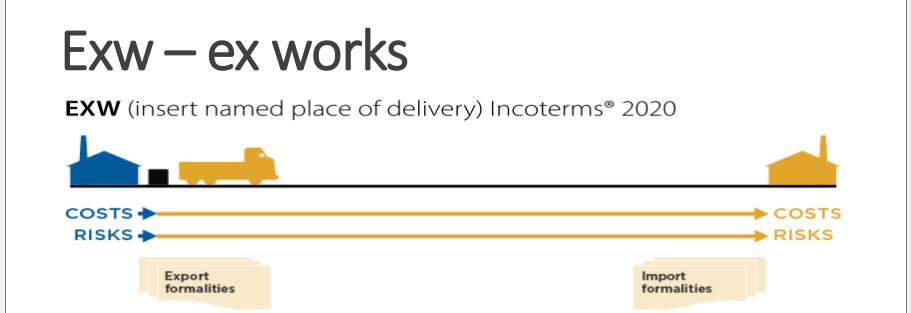
EXW means the seller delivers by placing the goods at the buyer’s disposal at a named place. That place is typically the seller’s own factory or warehouse, though it doesn’t have to be. For delivery to count as complete, the seller does not need to load the goods onto the collecting vehicle, nor clear them for export.
Seller’s side: supply the goods and commercial invoice, cover checking, packaging and marking, and deliver on the agreed date. The seller carries no obligation to arrange a contract of carriage.
Buyer’s side (maximum obligation): take on all risk from the moment of delivery. Arrange and pay for carriage, insurance, and loading and unloading. Hand the seller proof of taking delivery. Handle every export, transit, and import clearance formality.
That last point is EXW’s practical weak spot. The seller has no formal role in export clearance, so a foreign buyer with no local presence can struggle to complete it. That gap is a common reason exporters steer international buyers toward FCA instead.
FCA (Free Carrier): Category F’s Release of Liability
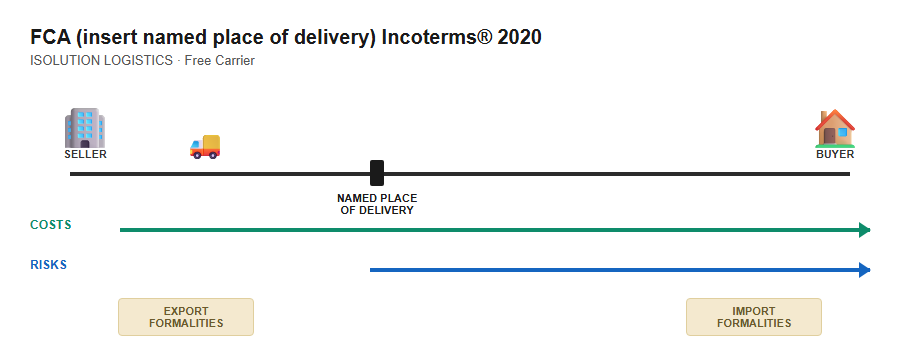
FCA leads Category F alongside FAS and FOB. The letter “F” stands for Free: once the seller hands the goods to the carrier at the named place in the export country, it sheds further liability, because the buyer, not the seller, must contract for main carriage.
Under FCA, the named place changes what “delivered” means:
- At the seller’s premises: delivery happens once the seller loads the goods onto the transport the buyer arranged
- At another location, such as a terminal or transit warehouse: delivery happens once the goods, still on the seller’s own transport, reach that place and stand ready for the buyer’s carrier to unload
Seller’s side: everything EXW requires, plus clearing the goods for export, plus loading them onto the buyer’s transport when the named place is the seller’s own premises.
Buyer’s side: take on risk from the point of delivery. Arrange and pay for transport, insurance, and import clearance. Accept the seller’s proof of delivery, or instruct the carrier to issue the seller a transport document instead.
Incoterms 2020 added one fix specific to FCA. If the parties agree, the buyer must instruct its carrier to give the seller a transport document confirming the shipment went on board, such as a bill of lading with an onboard notation, at the buyer’s cost and risk. This closes a longstanding gap for sellers who get paid under a letter of credit that requires proof the shipment went on board, even though FCA’s own risk transfer happens before loading.
How FCA Pricing Builds on EXW
Because FCA is essentially EXW plus a bit more seller involvement, its price builds directly on the EXW price:
- FCA at the seller’s premises = EXW + export customs clearance + loading fee
- FCA at a transit warehouse = EXW + export customs clearance + domestic transportation cost to that warehouse
That relationship explains why quoting in FCA terms, rather than EXW, is often the safer default for cross border sales. The extra cost is small and predictable. The risk it removes, a buyer stuck without local export know how, can be substantial.
Real World Example
A Vietnamese exporter sells 2 containers of tea to a US buyer from its factory in Vinh Phuc. Selling FCA at the Vinh Phuc factory adds only one job beyond EXW: the exporter clears export customs and loads the containers onto the truck the buyer sends, while the buyer arranges and pays for that truck. On a later order, the same buyer instead takes delivery at a transit warehouse in Hanoi. Now the exporter also arranges and pays for the domestic transport from Vinh Phuc to Hanoi, and delivery only counts once the containers sit at the warehouse, ready for the buyer’s carrier to take over. Either way, export clearance stays with the exporter. That is the one difference from a plain EXW sale.
Which One Should You Choose?
EXW gives the seller the lightest possible obligation and can suit a buyer who already runs its own pickup and export process in the seller’s country. FCA is the safer default for most cross border sales. It keeps export clearance with the party best able to handle it, the seller, while still handing off risk before the more expensive and variable leg of the journey.
ISOLUTION LOGISTICS HELPS YOU CHOOSE BETWEEN EXW AND FCA
🌐 Incoterm & Route Consulting: we assess your buyer, route, and cargo to recommend the term that avoids unnecessary delay or cost.
📦 Export Clearance Handling: full customs brokerage at origin, so FCA shipments move without the clearance gap EXW can create.
📄 Full Documentation Support: commercial invoice, bill of lading, packing list, certificate of origin.
👤 Single Point of Contact: one dedicated coordinator from quote to final delivery.
Not sure whether EXW or FCA is the safer term for your next shipment? Contact ISOLUTION LOGISTICS today for a tailored recommendation and competitive quote.
📌 ISOLUTION LOGISTICS JOINT STOCK COMPANY
🏡 20, Street 2/9, Hai Chau Ward, Da Nang City, Viet Nam.
📞 (+84) 379 009 001 / Whatsapp: (+1) 6395382612
📪 contact@isolutionlogistics.vn
🌏 https://isolutionlogistics.vn
📌 ISOLUTION LOGISTICS LAO CO., LTD.
🏡 No. 569, Cluster 37, DongPhosy Village, Hatsaiphong District, Vientiane, Lao PDR
Want more details?
Contact us directly via WhatsApp, Zalo, or Facebook Messenger for immediate assistance.
References:
Keep Reading: