



This is Part 2 of ISOLUTION LOGISTICS’ Incoterms 2020 series. Part 1 covered EXW and FCA, the two rules where the buyer arranges and pays for the main carriage. This part turns to Category C: CPT and CIP Incoterms 2020, the two rules where the seller pays for carriage to the named destination, while risk still passes to the buyer earlier in the journey, at the point of delivery to the first carrier.
IN THIS ARTICLE
Category C: Cost and Carriage, Explained
The letter C stands for Cost, or Carriage. In every Category C rule, the seller must contract and pay for carriage to a named destination. That is where the similarity with the D rules (delivery at destination) ends.
Category C has two critical points that do not move together. The seller pays the freight to the named destination. The buyer, though, takes on the risk of loss or damage much earlier. That risk shifts at the point where the goods are handed to the first carrier. A shipment can sail across the ocean at the seller’s cost. Yet the risk of a container going overboard already sits with the buyer. That split is the one idea every C term shares.
Category C actually has four rules: CPT, CIP, CFR and CIF. CPT and CIP are omni modal, they work for any mode of transport, including multimodal and containerized cargo. CFR and CIF are marine restricted, they only apply to sea and inland waterway transport. Under those two rules, risk transfers once the goods are on board the vessel. This article covers CPT and CIP Incoterms 2020. CFR and CIF, the two Category C rules built specifically around a vessel, are covered separately.
CPT (Carriage Paid To): Two Places, One Contract
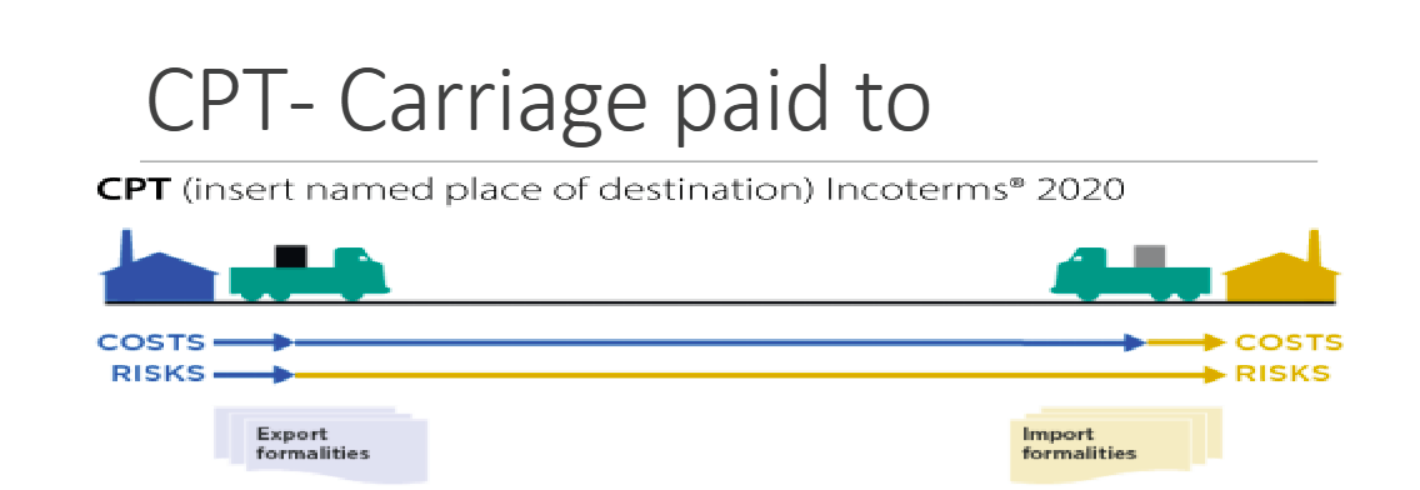
CPT means the seller delivers the goods, and transfers the risk, to the buyer. This happens when the seller hands the goods to the carrier it contracted, or procures goods already delivered that way. The seller gives the carrier physical possession of the goods in the manner appropriate to the mode of transport used.
Seller’s side: provide the goods and commercial invoice, and bear all risk until the goods reach the first carrier. Contract and pay for carriage to the named place of destination, and cover any unloading charges assigned to the seller. Handle export clearance and give the buyer the usual transport document.
Buyer’s side: take on risk from the point of delivery to the first carrier, and take delivery at destination. Pay import clearance costs and any unloading costs not already covered by the seller’s contract of carriage. Arrange insurance if wanted. Also give the seller notice of the dispatch time or receiving point whenever the contract lets the buyer choose it.
A CPT contract needs two locations, not one. The place of delivery is where risk passes to the buyer, often a warehouse or terminal in the seller’s country. The named place of destination is where the seller’s cost obligation ends. That second point, the destination, is the one that belongs in the contract wording. The format is CPT plus the named place of destination plus Incoterms 2020. Naming the pickup location instead of the destination is a common drafting mistake. It leaves the actual endpoint of the seller’s carriage obligation unstated.
CIP (Carriage and Insurance Paid To): CPT Plus Mandatory Insurance
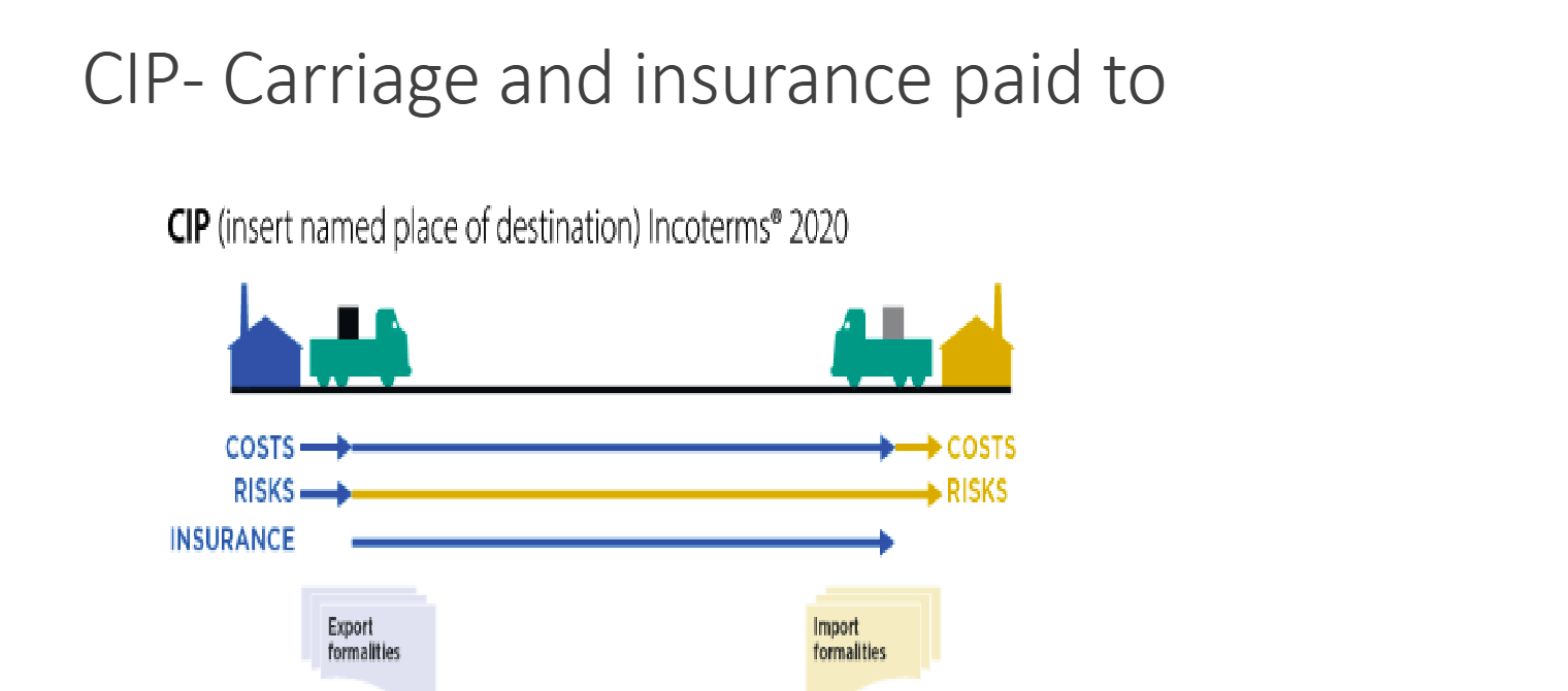
CIP works exactly like CPT, with one addition. The seller must also buy cargo insurance covering the buyer’s risk from delivery to the named destination.
Incoterms 2020 raised the minimum insurance standard for CIP specifically. Unless otherwise agreed, the seller must obtain cover complying with Institute Cargo Clauses (A), the broadest all risk cover available. This is a stronger standard than the minimum Clause C cover that CIF still defaults to. This was one of the headline changes in the 2020 revision. It means CIP now carries meaningfully stronger buyer protection than CIF by default.
Other insurance requirements under CIP:
- Cover must reach at least 110 percent of the contract price, in the currency of the contract.
- The insurer must be a reputable underwriter or insurance company. The policy must also let the buyer, or anyone else with an insurable interest, claim directly.
- The seller must hand the buyer the insurance policy or other evidence of cover. The seller must also give whatever information the buyer needs to arrange additional cover if wanted.
- If the buyer asks for extra cover, such as war or strikes clauses, the seller must arrange it. The cost falls on the buyer.
How CPT and CIP Incoterms 2020 Pricing Works
Because CIP is CPT plus insurance, and CPT is FCA plus freight, the three prices build on each other in a fixed order:
- CPT = FCA + Freight
- CIP = CPT + Insurance = FCA + Freight + Insurance
The insurance fee itself is not calculated on the CPT price. It is calculated on the CIP price, the number that already includes the insurance fee being solved for. Here I is the insurance fee, R is the insurer’s premium rate, and P is the seller’s expected profit margin. The formula is I equals CIP multiplied by one plus P, multiplied by R. Rearranged, CIP equals CPT divided by the quantity one minus R multiplied by one plus P.
A short example: a seller quotes 750 USD per metric ton CPT for a coffee shipment. The buyer asks for Institute Cargo Clauses (A) cover and a CIP quote instead. The insurer’s premium rate is 0.3 percent and the seller’s expected profit margin is 10 percent. Applying the formula, CIP equals 750 divided by the quantity one minus 0.003 multiplied by 1.10. That comes to roughly 752.5 USD per metric ton, an insurance fee of about 2.5 USD per metric ton. The gap looks small because the premium rate is small. But the calculation always runs on the CIP figure itself, not on the CPT starting point.
Real World Example
A Vietnamese exporter in Da Nang sells industrial equipment to a buyer in Vientiane, Laos. They agree on CPT terms for door to door trucking through the Lao Bao border gate. The exporter hands the cargo to its contracted trucking company at the Da Nang warehouse. That is the place of delivery. The carrier then carries the goods all the way to the buyer’s warehouse in Vientiane, the named place of destination.
The correct contract wording is CPT Vientiane, Laos, Incoterms 2020, naming the destination, not CPT Da Nang, Vietnam. Risk already passed to the Lao buyer the moment the goods were loaded onto the truck in Da Nang. That is well before the shipment reaches the Lao Bao border crossing. If the cargo is damaged during the cross border journey, the buyer bears that loss. This includes delays or mishandling at the border gate. This is true even though the exporter is the one paying the trucking company for the entire route to Vientiane.
Which One Should You Choose?
Choosing between CPT and CIP Incoterms 2020 comes down to who should arrange the cargo insurance. CPT suits a buyer who already carries reliable cargo insurance, or is comfortable self insuring. That buyer mainly wants the seller to handle booking the carriage. CIP suits any shipment of meaningful value where the buyer wants guaranteed all risk cover from the point of delivery. That buyer then does not have to arrange that insurance itself.
Both terms also fit containerized and multimodal cargo better than their marine only counterparts, CFR and CIF. CPT and CIP transfer risk once goods reach the first carrier, rather than once they are on board a vessel. That distinction matters for cargo delivered to a container terminal rather than loaded ship side.
ISOLUTION LOGISTICS HELPS YOU CHOOSE BETWEEN CPT AND CIP INCOTERMS 2020
Incoterm and Route Consulting: we assess your buyer, route and cargo value. We then recommend the term that avoids unnecessary cost or coverage gaps.
Marine Cargo Insurance Arranged Under Clause A: full all risk cover placed with reputable underwriters. Coverage is sized correctly at 110 percent of contract value.
Full Documentation Support: commercial invoice, bill of lading or equivalent transport document, insurance policy, packing list, certificate of origin.
Single Point of Contact: one dedicated coordinator from quote to final delivery.
Not sure whether CPT or CIP is the safer term for your next shipment? Contact ISOLUTION LOGISTICS today for a tailored recommendation and competitive quote.
📌 ISOLUTION LOGISTICS JOINT STOCK COMPANY
🏡 20, Street 2/9, Hai Chau Ward, Da Nang City, Viet Nam.
📞 (+84) 379 009 001 / Whatsapp: (+1) 6395382612
📪 contact@isolutionlogistics.vn
🌏 https://isolutionlogistics.vn
📌 ISOLUTION LOGISTICS LAO CO., LTD.
🏡 No. 569, Cluster 37, DongPhosy Village, Hatsaiphong District, Vientiane, Lao PDR
Want more details?
Contact us directly via WhatsApp, Zalo, or Facebook Messenger for immediate assistance.
References:
Keep Reading: